Austria in transition: 1918 - 1921
The 1920s Anschluss (that didn't happen)
As the war staggered to its end, many politicians believed that, shorn of its sources of goods and food, the only salvation for "today's Austria" lay with a union with Germany.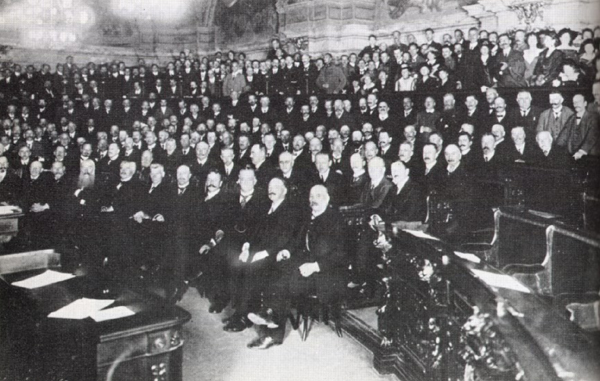
This photograph shows the German-Austrian National Assembly meeting in October 1918
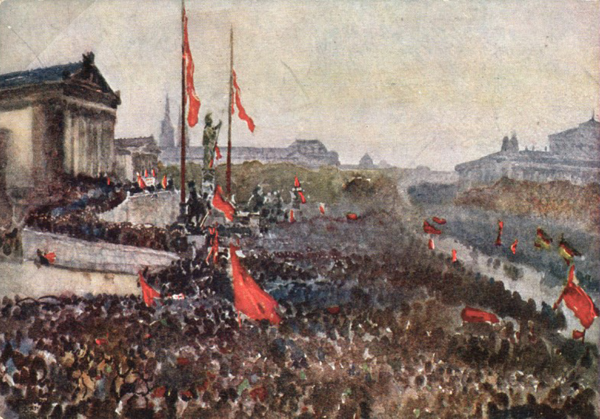
Crowds outside the Parliament Building on 12 November 1918 acclaiming the proclamation of the Deutsch-Österreich Republic, as enshrined in Article 2 of the Constitution unanimously decided by the German-Austrian National Assembly on that day
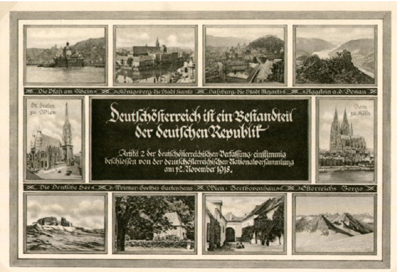 | 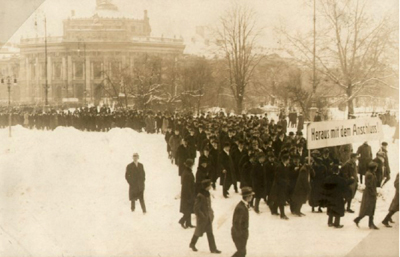 |
| Card with scenes from Germany and Austria issued by the Austria-German People's Union asserting that "German Austria is a part of the German Republic". | Not everybody shared this opinion! An Anti-Anschluss march in the snow at the front of the Vienna Town Hall, with the Bürgtheatre in the background. The slogan on the banner reads "Heraus mit dem Anschluss!" (Down with the Anschluss!). |
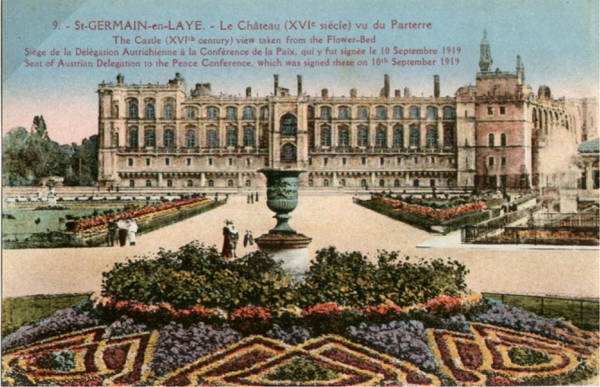
In 1919, the victorious Allies imposed treaties to determine the fate of their former enemies. The Treaty of Saint Germain on 10th September 1919 saw the dismembership of the Austro-Hungarian Empire and recognised the independence of Czechoslovakia, Poland, Hungary, and the Kingdom of Serbs, Croats and Slovenes. The aspirations of the newly-created land-locked Republic of Austria received little attention.
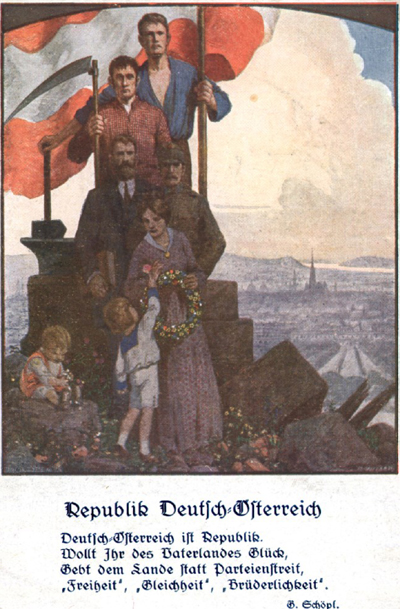
Propaganda postcards came in profusion
 |
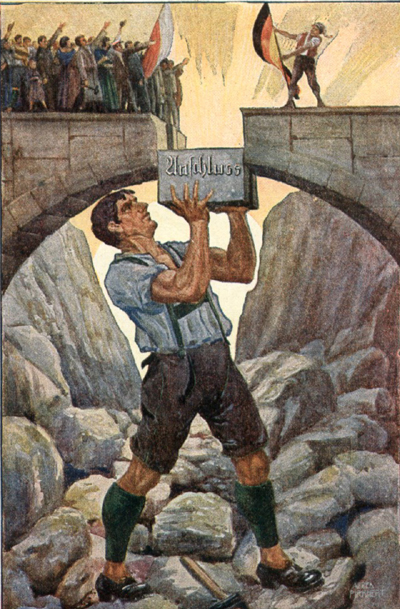 |
| "German-Austria is a Republic. / Do you want happiness for the fatherland, / Unite the country instead of party dispute, / Freedom, Equality, Fraternity." | Pro-Anschluss Postcard from the first months of 1920. "They wanted to keep us apart, / we have come to the point, / we want to complete the bridge, / because there is strength in unity." (But the keystone is unstable…) |
©APS. Last updated 21 March 2023