Austria in transition: 1918 - 1921
The Carinthian plebiscite issue of 1920
Introduction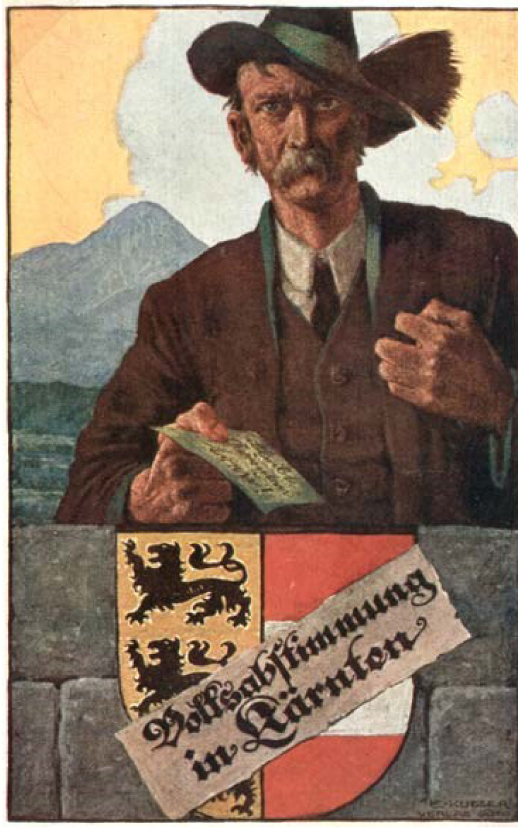
The border between Austria and the Kingdom of the Serbs, Croats, and Slovenes (later Yugoslavia) was dictated by the Treaty of St Germain under which the major part of the territory of the former Austrian Crownland of Carinthia was allocated to Austria. The border was the Karawanken mountain range, with many Slovenes remaining in Austria. Serbian troops promptly invaded, seeking to force a change in this decision.
Three parts of Carinthia (Kanaltal, Seeland, and Mießtal) were handed over to other countries. So far as the Postal Historian is concerned, this included the post offices at Gutenstein, Köttelbach, Leifling, Mießß in Kärnten, Ober Seeland, Prävali, Schwarzenbach, Unter Drauburg, Pontafel, Tarvis, Malborgeth, Raibl, Uggowitz, Saifnitz, and Lussnitz; and their associated Postablagen.
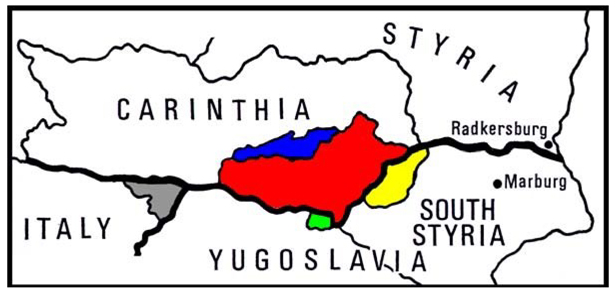
Grey = Kanaltal, transferred to Italy; green = Seeland and yellow = Mießtal, both transferred to the future Yugoslavia; red = plebiscite zone A; dark blue = plebiscite zone B.
As part of the provisions of the Treaty, a plebiscite was held on 10 October 1920 to decide whether Carinthia should remain as a province of Austria or should be joined with the new Kingdom of the Serbs, Croats, and Slovenes. Legalistically, during the period of the plebiscite the province was not attached to either state, but both Austria and Jugoslavia overprinted stamps for use (and for propaganda).
For the purpose of the plebiscite, the disputed territory was divided into the south, Zone A (comprising the districts of Bleiburg, Rosegg, Ferlach, and Völkermarkt), and the north, Zone B (Klagenfurt area). The plebiscite was to be held first in Zone A, then Zone B three weeks later but only if Zone A had voted to join Yugoslavia. During the plebiscite itself, British and Italian officers kept order and the Yugoslavian troops were ordered by the Supreme Council to place themselves under the orders of the Plebiscite Commission. Everyone over the age of 20 with residential qualifications was entitled to vote. The plebiscite was overseen by an Inter-Allied Plebiscite Commission. The result for zone A was 22,025 votes in favour of Austria which is 59.04% of the votes. "The people had spoken", so in conformity with the Treaty of St. Germain the Austrian victory in this zone rendered a plebiscite in the northern zone unnecessary and the whole region went to Austria. Interestingly, if one presumes that the whole German-speaking minority had voted for Austria, so also did about half the Carinthian Slovenes.
Official Austrian Issues
An organisation called the Kärntner Heimatdienst was founded in 1920 to further the interests of Austria in general and of German-speakers in Carinthia in particular, especially in the imminent plebiscite. It sought the issue of fund-raising propaganda stamps, which was approved on 9 September 1920.
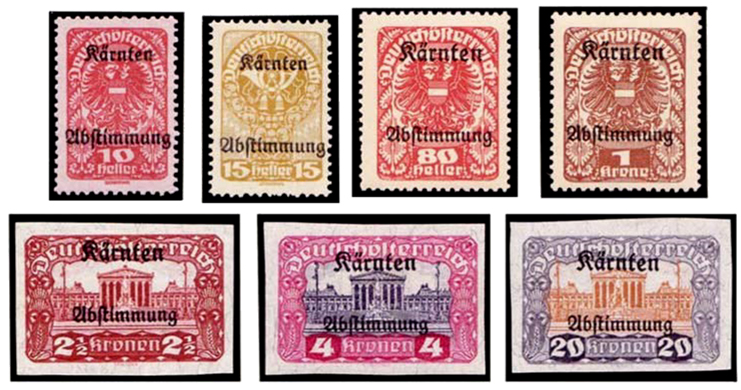
A set of 19 stamps (catalogued as ANK 321-339) overprinted "Kärnten Abstimmung" (Carinthia Plebiscite) for the vote on 10th October 1920 were put on sale on 16th September. These stamps were sold throughout Austria at three times their face value to raise money for the plebiscite and to assist people who held residential qualifications in Kärnten (Heimatrecht) to return and vote in the plebiscite. There was a total of 300,000 complete sets plus various quantities of all values except the 30h and 60h.
The Austrian Post Office produced a special printing of two existing designs: the Parliament Building of 1919/21 and the Republican Arms of 1920/21. There was no time for a new design, so 19 previous stamps were printed in new colours, some on coloured papers (probably all that was available), and with a black typographed overprint "Kärnten Abstimmung". The narrower low-value stamps were printed on coloured papers, and the low values were comb perforated 12½. The values from 2½ Kronen upwards (ie the Parliament Building design) were imperf on granite paper; as before, the two-colour stamps were printed in two operations.
The "Handbuch Kärntnen 1980" (p116) adds that as well as sponsoring the issue the Kärntner Heimatdienst bought 252,000 of the sets and 28,000 of various values, either at face value or at cost-of-printing; then sold them to the public in Klagenfurt. The remaining 48,000 sets and assorted values were sold at three times face value through the post offices of the northern zone of the plebiscite region in Carinthia. The excess over the face value was used to support a propaganda fund to organise the voting in favour of staying in Austria. The stamps, however, were valid for the whole of Austria up to 10 October 1920; the day of the plebiscite.
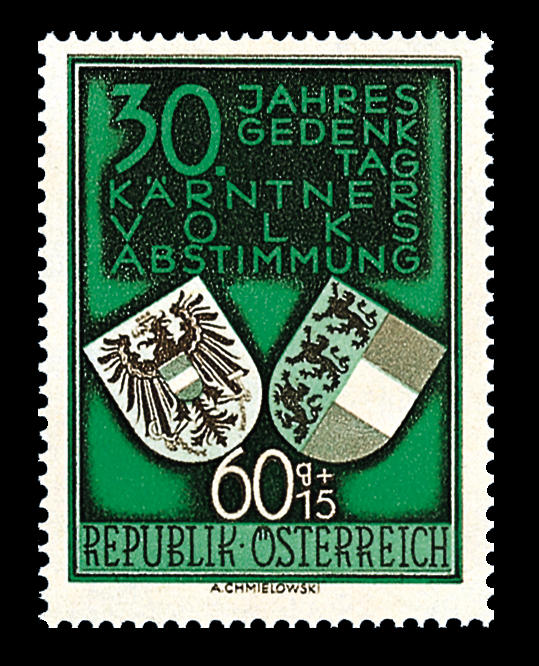
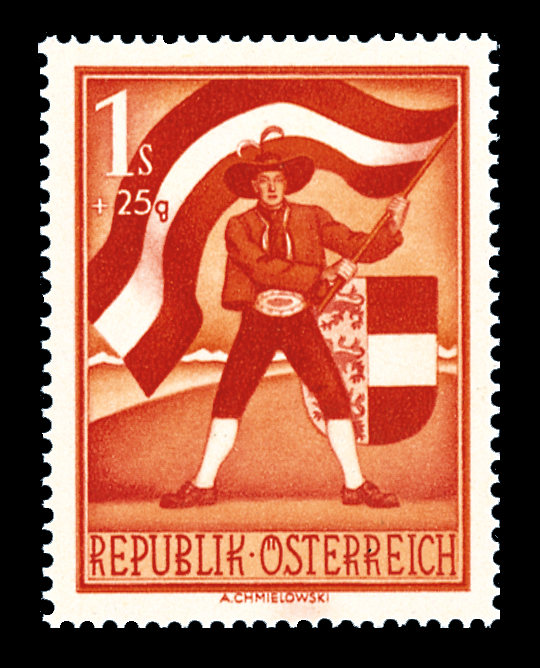
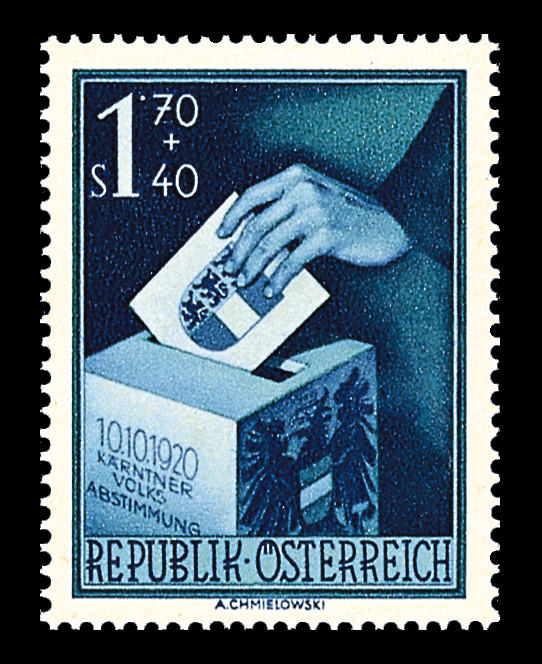
The set ANK 964-966 was issued by Austria Post for the 30th anniversary.
Austrian propaganda issues
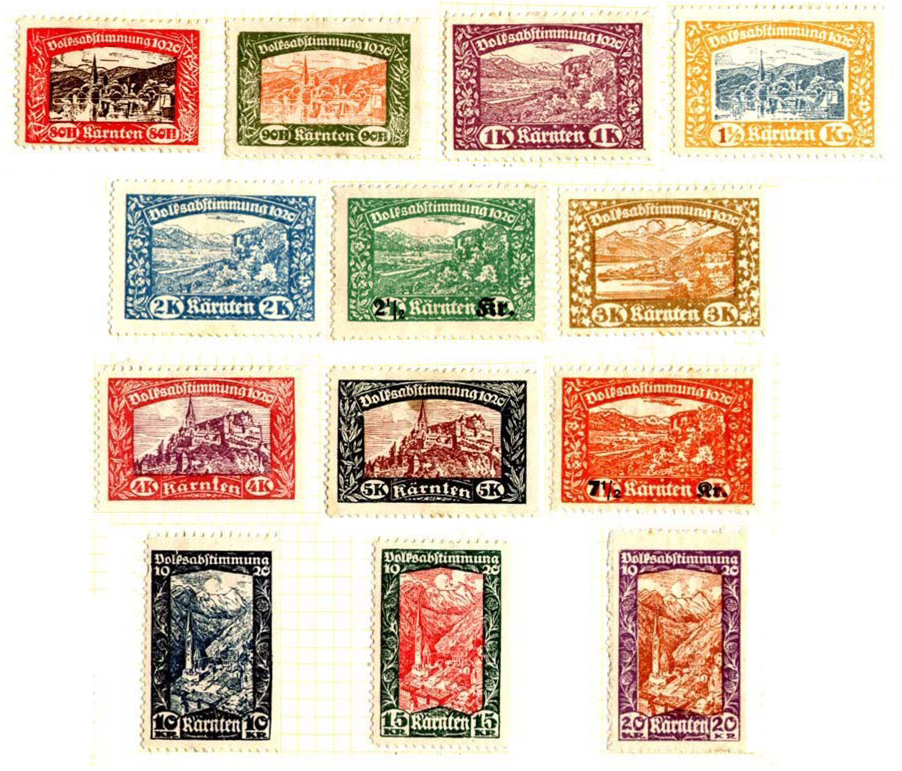
Privately printed Propaganda stamps, 2 printings in Innsbruck or (and ?) Klagenfurt.
Inscribed "Volksabstimmung 1920 Kärnten" and showing views of Carinthia.
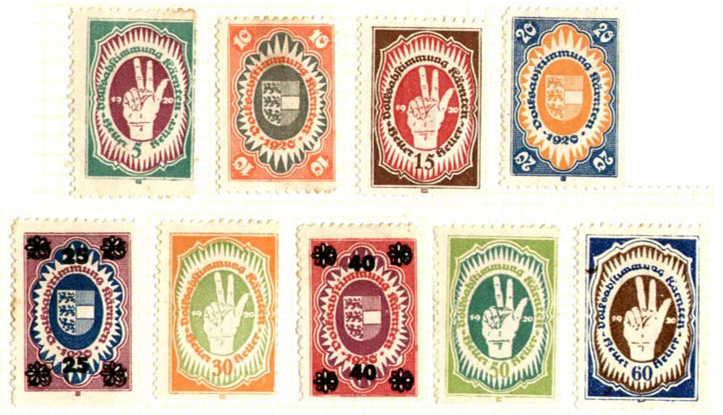
'Taking the Oath' and the 'Carinthian Shield' - propaganda essays.
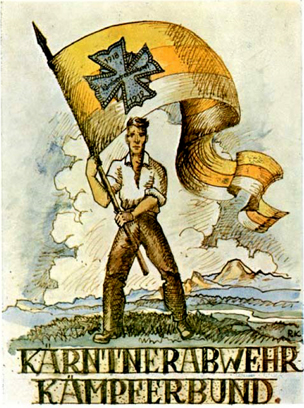 | | 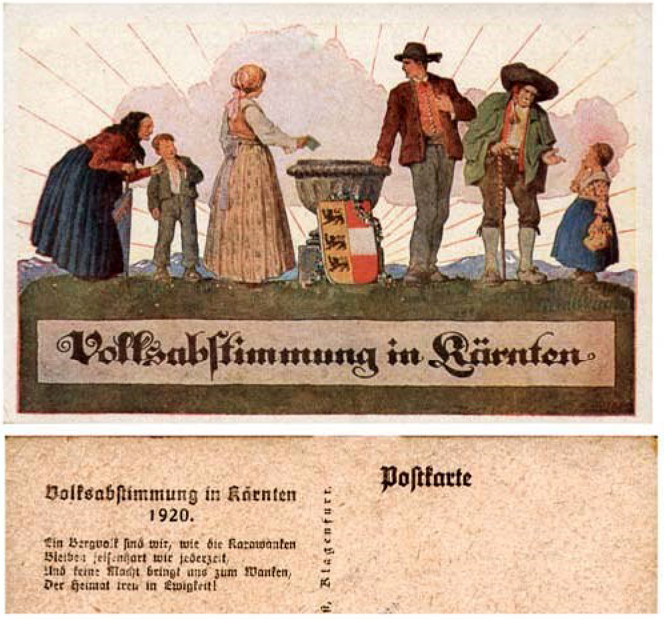 |
Numerous propaganda postcards were produced.
On the left is one from the Kärntner Defence Fighting Fund;
on the right three generations of a family have come to vote. |
Official Yugoslavian issues
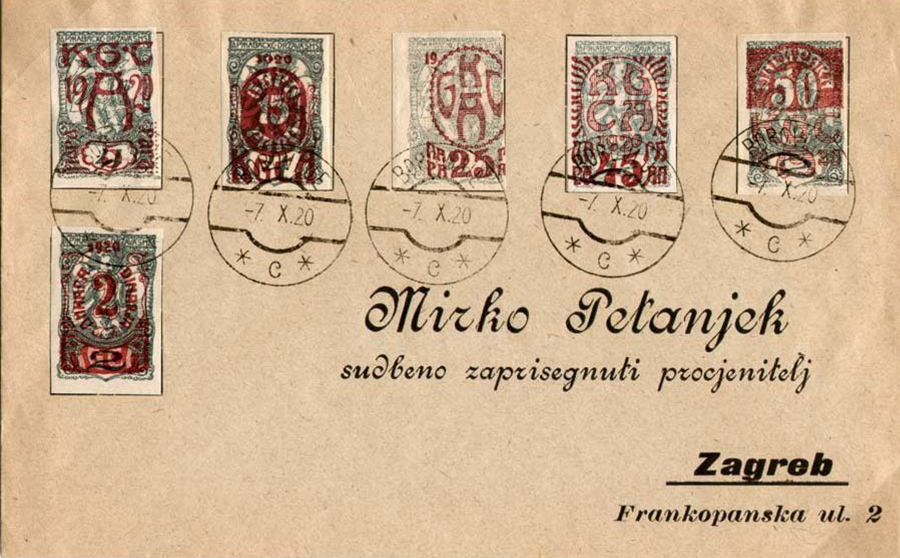
Similarly, the Kingdom of Serbs, Croats, and Slovenes (which became Yugoslavia in 1927) produced and sold overprinted stamps in the southern zone; but they didn't start the process until the day after the Austrian stamps were placed on sale - presumably they were caught out! - so theirs didn't go on sale till 29 September. Six imperf newspaper stamps overprinted in red-brown with KGCA (to signify "Karinthian Governmental Commission, Zone A") and a new value were issued in Ljubljana and sold for the Plebiscite at three times face value to aid the Propaganda Fund.
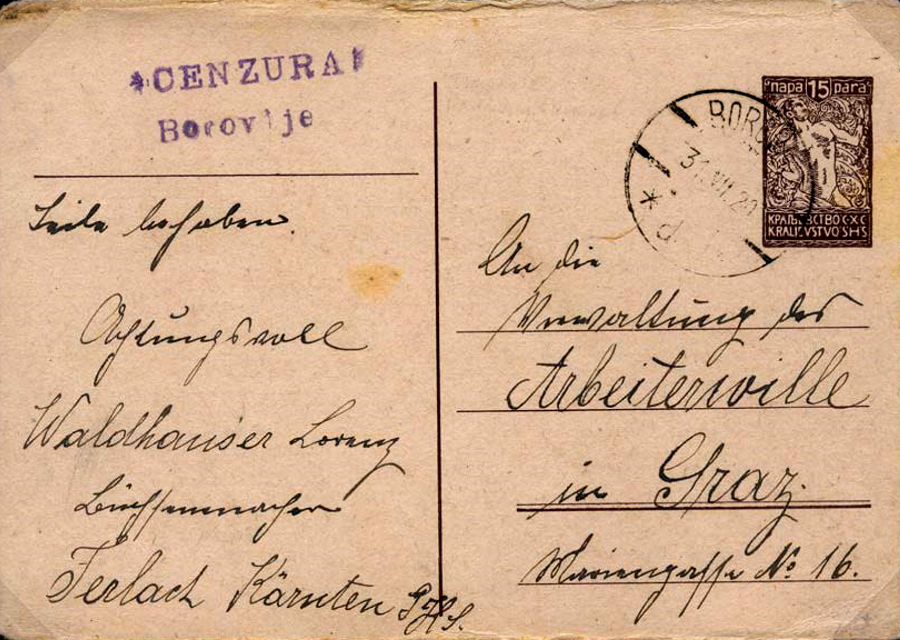
Because of the disputed border, some deemed Carinthia to be a part of the Kingdom of Serbs, Croats and Slovenes (SHS). The card above carries the 'SHS' postmark and censor of "Borovije" (Yugoslavian name for the Austrian town of Ferlach, just 16km south of Klagenfurt) with the senders address clearly stating "Ferlach Kärnten / SHS". The card was sent on 31.VII.20 in the run-up to the plebiscite.
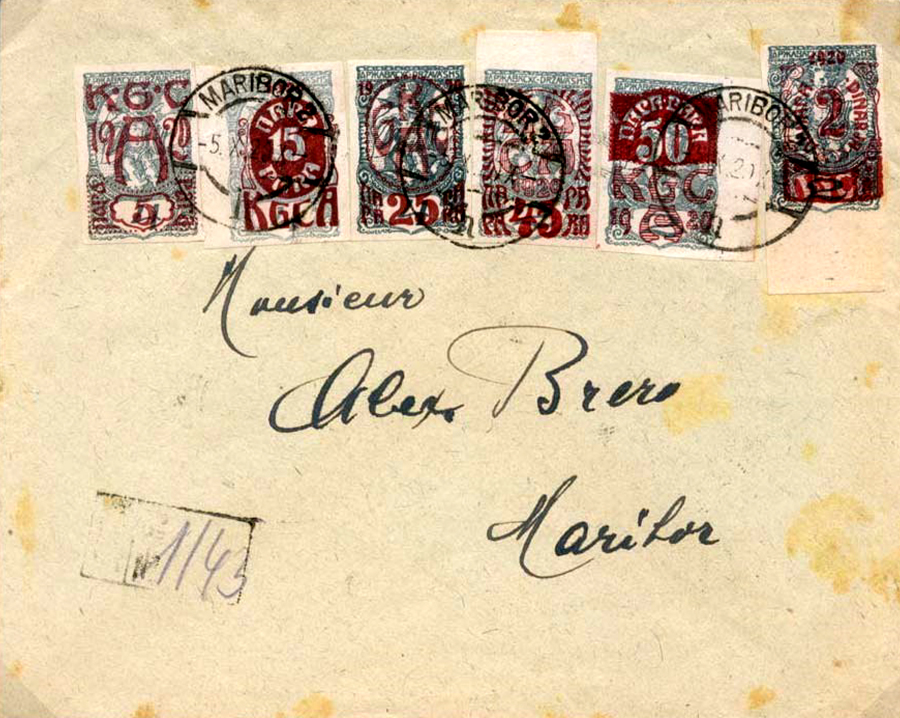
Local registered letter, Maribor 2, 5.X.20.
For the purpose of the plebiscite, the disputed territory was divided into the south, Zone 1, and the north, Zone II. The plebiscite was to be held first in the south, then in the north three weeks later but only if the south had voted to join Yugoslavia. A 95% turnout voted 59% for Austria and 41% for Yugoslavia, so the second vote did not take place.
By kind permission of the Editor of Jugoposta, Nick Coverdale, an article by Judith Hurst from Issue No 5 (1985) follows. It describes the Ljubljana issue from the Kingdom of Serbs, Croats, and Slovenes point of view.
The Carinthian Plebiscite Issue Of 1920
The aftermath of World War I produced many boundary disputes. One of great interest to Yugoslavia collectors is the dispute between Austria and the newly formed Kingdom of the Serbs, Croats and Slovenes concerning the area of Carinthia (Kärnten to the Austrians, Koruška to the Slovenes). This area had been settled by the Slovenes since about the sixth century but had been part of the Habsburg Empire until 1918. The new kingdom had been granted a small area of Carinthia by the Treaty of St Germain in 1919, but claimed the whole area in view of the number of Slovene inhabitants. It was decided that a plebiscite or referendum should be held. The area was divided into two zones, A and B: A the rural forest area of Upper Carinthia and B the area around the city of Celovec (Klagenfurt). In order to raise money to promote the plebiscite, both countries issued special stamps which were sold at a premium
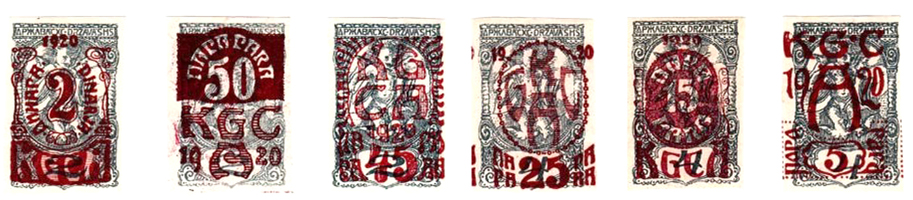
As an economy measure it was decided not to issue a new design, but to overprint an existing issue. The stamps chosen were the Slovenia newspaper stamps of 1919. The Post Office rejected the overprint design suggested by Vavpotic, the designer of the original stamps, and chose instead the design of the Ljubljana artist Koželj. This consisted of the initials KGCA in a decorative border together with the new values. (K. G. C. A. = Koroška Glasovatelna Cona-A ie Carinthian Plebiscite Zone A.) The overprint was done by the Yugoslav Press, Ljubljana. The values and numbers printed are shown below. All stamps were sold at 3 times face value.
Face values and quantities sold: 5 para on 4 dinar: 478,400; 15 para on 4 dinar: 358,000; 25 para on 4 dinar: 358,000; 45 para on 2 dinar: 185,720; 50 para on 2 dinar: 356,640; 2 dinar on 2 dinar: 89,040.
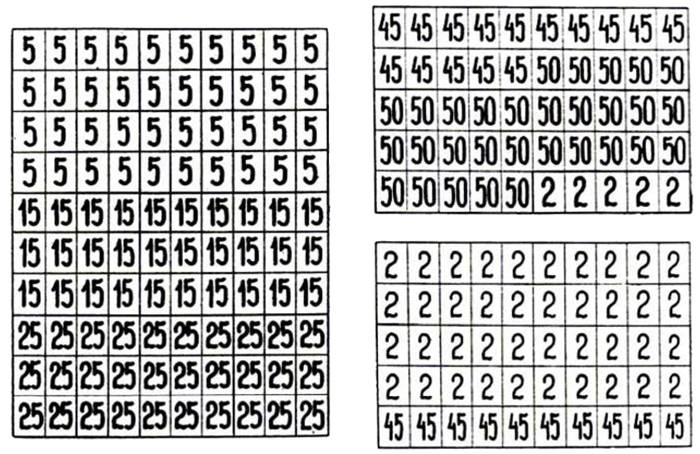
The original stamps were printed in sheets of 100 (10x10). Apparently the three lower-value overprints were applied to the sheets of 100 of the 4 dinar, but the 2 dinar sheets were cut in half before the higher-value overprints were applied. Two printings of the higher values were done, possibly to give more of the 2 dinar value and hence increase the number of complete sets available (to sell to collectors?). It is obvious that many interesting combinations of values arise from this method of printing, and some of these are extremely scarce. The diagram shows how the overprint was applied. The exact date of issue seems uncertain but was probably at the end of September 1920. The stamps were not valid in Serbia or Montenegro. They were valid for postage until 31 October 1920. Unsold stamps were purchased by dealers. Essays and plate proofs of the overprint are known to exist.
©APS. Last updated 21 March 2024