| Back to main Wien 25 narrative | On to item 2 |
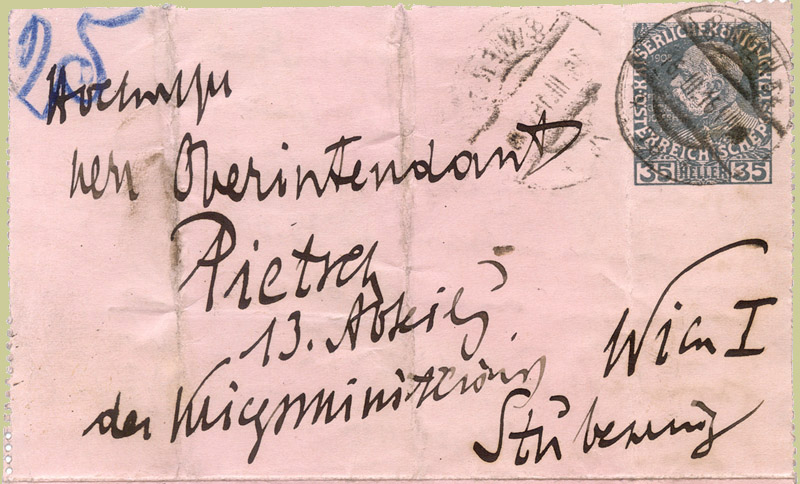
The first item was sent in 1916 to the Kriegsministerium. It’s a pneumatic-post letter-card, with a 35 heller Jubilee-design imprinted stamp, the outside is rose and the inside grey-green (it’s Schneiderbauer’s 12y). The franking is correct (and the card was issued) for the special pneumatic-post letter-card rate of 35 heller valid between 16.1.1907 and 30.9.1916.
The front carries the address: Hochgeehrter / Herr Oberintendant / Pietsch / 13. Abteilung / der Kriegsministerien Wien I / Stubenring. [It should be "des Kriegsministeriums", not plural as written: Dual Monarchy, but single War Ministry!]. An Oberintendant was a senior civil servant; Abteilung means Department or Section.
This was the author’s first-ever Kriegsministerium item, so will be discussed in more detail than the others.
The imprint is cancelled with a doubled strike of the bridge cancel 8 WIEN 64 / 16.III.16.VIII.■ / * 7b * (where ■ is a Balk, ie the minutes slug is upside down). This is Stohl type R0033f. To the left of this is a reversed offset of the same - also doubled, and perhaps caused when the card was folded (the creases are visible on the illustration). Wien 64 is now Wien 1082 in Josephstadt, Bez 8, and was a pneumatic station for the entire life of the system. The cancel time is 8am, which is when the system started up for the day. The blue 25 at the top left front is precisely what would be expected for a standard Instradirungschiffre, the number of the destination pneumatic office, which by 1916 was the same as the Post Office number. There is no WIEN 25 arrival or delivery cancel - but then it wasn’t being taken out to anywhere else, just delivered within the building.
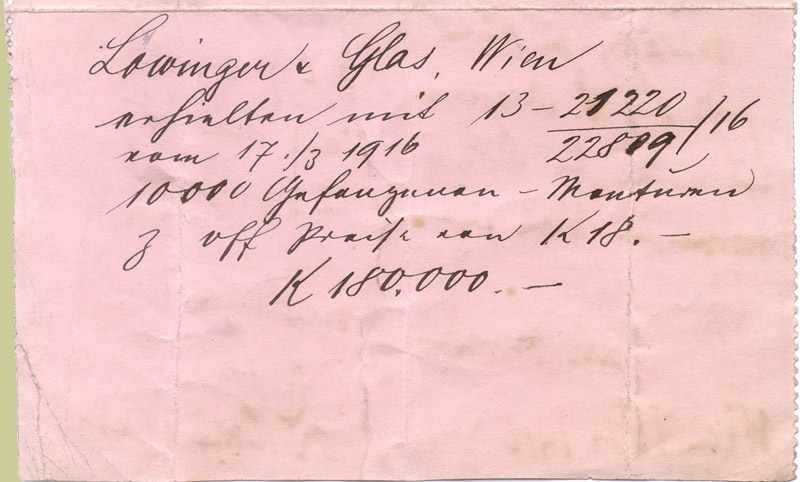
There is no arrival or delivery cancel on the back either, nor any indication of who sent it. The quite different hand-writing on the back is perhaps that of the addressee. It says "Lowinger & Glas, Wien", a transaction or file reference number, a date of 17/3 1916, and a price of (or note of an order for) 10,000 prisoners’ uniforms at 18 K each, or 180,000 K.
The message inside is in the same hand as the address, and is dated Wien 15/3/1916. The writer has meticulously put an arc above each letter ‘u’ to distinguish it from an ‘n’, and almost all is readable. The lack of introductory pleasantries and of a return address suggests they know each other well. It says:
Hochgeehrter Herr Oberintendant
Weil ich weiss, wie Sie in Anspruch genommen sind, so gestatte ich mir, auf diesem Weg wegen der Zuweisung der Lieferung von 30,000 Monturen für Gefangene an die Fa Löwinger & Glas freundlich zu ersuchen. Sie haben ihre Preise ermässigt, um nur die Arbeiter beschäftigen zu können, und warten mit Sehnsucht auf die Annahme des Offertes, da der Lieferant ??????????
Mit besonderer Hochachtung, Wien 15/3 1916 D. Scheiner
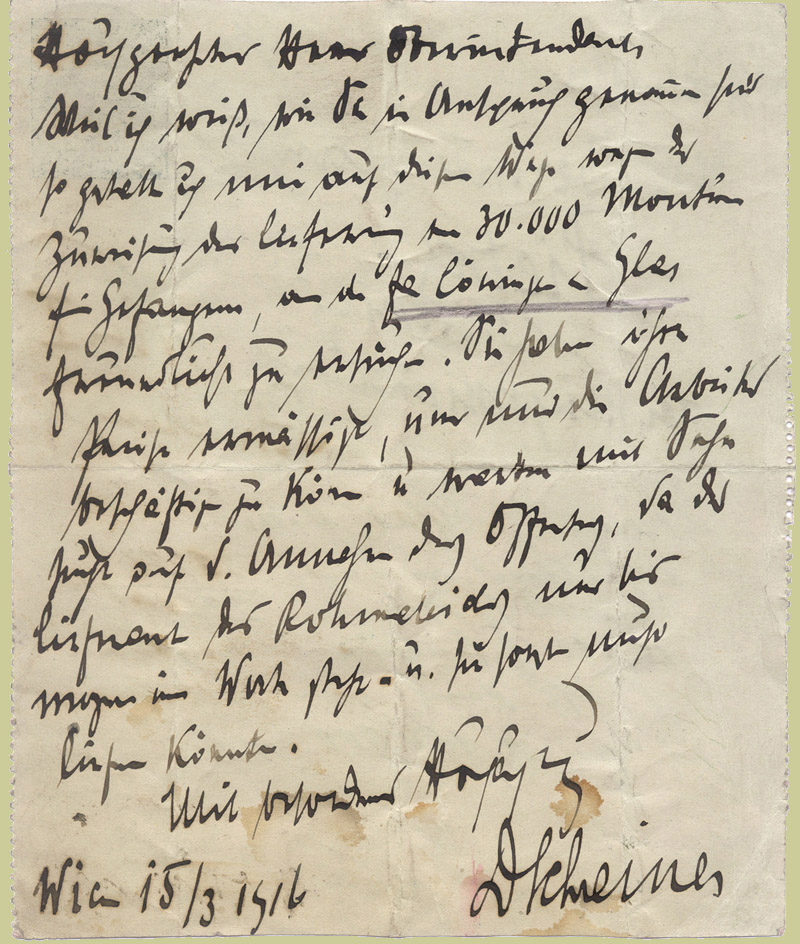
Many people in several countries have tried to read the words after "Lieferant", and a measure of interpretation has been necessary ("if A is X then B could be Y and cannot be Z"). The collective wisdom is:
| der Lieferant des | {Rohmaterials | nur bis morgen im Wort steht u. | {sie sonst | nicht liefern könnte |
| {Rohbekleidung | {sofort |
"Im Wort stehen bis" is an old set phrase similar to the commercial "das Angebot ist gültig bis" (= offer valid until). So the message says:
Dear Mr. Oberintendant
Because I know how busy you are, I have taken the liberty of hereby kindly requesting allocation of delivery of 30,000 uniforms for prisoners from the firm Löwinger & Glas. They have reduced their prices, simply to keep their workers occupied, and are now waiting very anxiously for acceptance of the quotation, since the supplier ?????
With particular regards,
Vienna 15/3 1916 D. Scheiner
The final portion means something like "their supplier of the raw material [or, specifically, "raw material for clothing" ie cloth] can only deliver [to the L&G workshop?] if it’s ordered by tomorrow" - it is however pretty clear that the matter has an urgency, justifying the use of pneumatic mail!
"Monturen" is either uniforms in general or greatcoats in particular. The "Gefangene" are most probably normal POWs. Although these would have been captured in uniform, the 1915-16 winter was bitterly cold (troops dying in tens of thousands) and additional clothing would have been justified if only to prevent the Red Cross complaining. Wilder speculations are possible but unjustified.
Oskar Schilling and colleagues state that Abteilung 13's responsibilities were: "Wirtschaftsgruppe (Monturverwaltungsanstalten, Bergestellen, Nagelschmieden und Skiwerkstätte, Bekleidungswerkstätte in Brunn a.G.); Bestellgruppen und Helmreferat (gesamte Erfordernisse an Montur)". This means "Administrative group for uniforms management and establishments, salvaged-material depots, boot-nail forging and skiing equipment, also the clothing workshop in Brunn am Gebirge; groups for sending out purchase orders and testing helmets, covering the total requirements for uniforms". There are records of firms called "Löwinger & Glas" working in the textile industry at Koniginhof an der Elbe/Králové nad Labem in 1872 and at Katharinberg/Katerinky in 1929; both these are in Bohemia.
The note on the back of the W25 letter card was, we guessed, in the handwriting of the recipient. It includes a number, amended to read 13-21220/22819 /16 which we surmised could be a file reference for Abt 13 for the year 1916. So the author went to the State Archives at Nottendorfer Gasse, looked up the do-it-yourself index for the Kriegsarchiv, and found there were two sets of relevant Protokollnummer indexes. He ordered both, and returned the prescribed time later to be presented with two rather large leather-bound ledgers, which turned out to be the register of outgoing correspondence. It lists every item by serial number; addressee and subject and date; unexplained codes; and comments. Not all entries had all fields complete. The entries are not in date order. The author is not listed. The first book was irrelevant; it was "Abt. TuLG" and the correspondence was all about leather and calf-skins in Bosnia. However in the second were these:
21220 Loewinger & Glas ·/· Anbot auf Monturen fuer K.G. "mit 22809". The ·/· is written in the date field, presumably meaning "same as on the previous line". Item 22809 is irrelevant, but recall that on the original it has been manually changed to 22819...
22818 BEERs Loew Wwe u. Sohn Holleschau 5/3 Anbot auf Blusen
22819 Idem 7/3 Anbot auf Monturen "mit 22033"
2203 RENNER v.BAND, J.V.MAUTNER 7/3 Anbot auf Mäntel
These seem to be around 5-7 March 1916, while our letter is the 15th. There was no time to order the documents themselves - even if they are still there - and return to view them. Maybe they are the enquiries, not the actual orders? Evidently Loewinger & Glas are regulars: 22811 was written to them concerning "Anbot auf Uebermäntel 4/3" and 22812 "Idem Anbot auf Blusen 6/3". So, we can reasonably conclude that the letter-card is indeed connected with an order on Loewinger & Glas for uniforms, and was sent urgently to the relevant civil servant.
| Back to main Wien 25 narrative | On to item 2 |