The technical details
Dr Hans Hajek's "Geschichte der Wiener Rohrpost" treats Office 25 in the same way as all the other offices served by pneumatic pipes. He states that Wien 25 was the number of the pneumatic station in the new Reichskriegsministerium, commissioned in 1913 and shutting in 1922. Station W25 is shown only on Hajek’s 1913 map; it does not appear on his earlier (1907) or later (1924) maps. His text on page 37 (para 2) notes that Wien 25 was opened in 1913. Page 50 at the bottom lists offices including Wien 25 that were closed for periods to save money. And page 63 lists sections of the system that during the 1918/19 winter when there was a great shortage of coal could only open when they received compressed air from an electrically-powered station; one is "I-25". The sections listed, he says, used messengers during periods of shutdown – his paragraph would make no sense for a section that always used messengers.
His appendix 1 is the system map of 1913, on which W25 is shown as linked to Fleischmarkt. Although these maps are schematic, the position is reasonable for the known locations of the buildings. His second appendix on his page 78 has "1913 – Wien 25 (Kriegsministerium)" under the heading "Errichtung neuer Rohrpoststellen" (opening of new pneumatic offices); by page 79 the heading has become "Veränderungen im Stande der Rohrpoststellen" (changes in status of pneumatic offices) and the entry is "1922 – Wien 25 aufgelassen" (closed).
Does there have to be a pipe?
The German text in the above-quoted decrees ("Einbeziehung ... in das Wiener Rohrpostnetz"; "Den bisher von diesen Postämtern besorgten Postzustelldienst hat das Postamt Wien 1 zu übernehmen") does not unequivocally state that the pneumatic service was provided by a pipe, only that it was provided somehow, and later was withdrawn, those who had been collecting their mail from the Wien 25 office having now to go to Wien 1 for it.
The special red letter-boxes for pneumatic post were in service at this time, and specially-assigned staff were employed to collect mail from them. They could have shuttled between Fleischmarkt and the Kriegsministerium: it’s about 10 minutes walk. The creases on the two items would however be pointless if they were to be hand-carried. Hajek’s book is unambiguous: the new Kriegsministerium was served by a pipe from Fleischmarkt.
The geography of Vienna means that a physical connection, running a new pipe from the existing pneumatics in Fleischmarkt to the Kriegsministerium, would require either a complicated routing through streets broad and narrow or a tunnel under Postgasse and the Postsparkasse, before digging up the newly-built Ring.
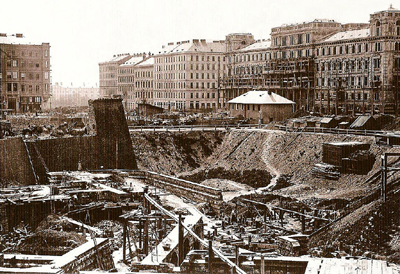 The geology of Vienna provides the answer. Digging downwards from modern street level in the Inner City, you will first find up to 5m of anthropogenic deposits dating back to the Romans, then some meters of a fine earth called Loess, then about 15m of Pleistocene gravel and then some hundred meters of bluish marls (clay, sand) of Pannonian age, originating from a lake. Going deeper you will get the brackish and then the marine sediments, the transgression sediments and finally the Alps. Under them is the Bohemian Massif; the Alps were extruded over it when the African plate crashed into the European plate: but by now we’re thousands of meters deep and only oil wells go there. (The picture is the excavation for the Opera House.)
So if I’m building Postgasse, I need to go down more than 20 meters, to the clay, before the ground will take the weight. The same will apply to Telegraph Central, the Opera - and the Kriegsministerium. Having dug my hole, there is no merit in filling it with a huge lump of concrete; and since 1900s pile-drivers couldn't cope with the soil conditions I do need the hole.
What to put in it? Cellars! Postgasse 8 had (Dr Kainz told me) at least three floors below street level; the one(s) deeper than the 2nd is/are now filled up. So the pneumatic pipes, which ran only a few meters under the pavements, would have entered the building at the level of the first basement. We have also found plans showing that Telegraph Central had the pneumatic compressors etc in a sub-basement; and in the Kriegsministerium the Post- and Telegraph-office was located in the Tiefparterre (lower ground floor) with a basement below it, and under that a sub-basement.